Monday, August 27, 2012

Santa Fe Bicentennial SD45-2's 1976 Piggybacks


Bicentennial Locomotives

In 1975 the Santa Fe railroad painted  five  SD45-2’s in a patriotic scheme to honor the nation.  They were split up in order to maximize their visibility,  spotted as the lead locomotive on priority piggyback trains, and seldom seen in pairs.  They were numbered 5700 to 5704.  They were quite popular with employees, shippers, rail fans, and the general public.


Bicentennial Locomotives 5703 and 5702 in front of the Needles, CA station durng a crew change.  Not normally seen in pairs.


Two custom painted MT trailers. the Gelco trailer has been modified with a refrigeration unit and fuel tank below the trailer.


Forty five foot Con Cor trailer  and stock MT trailer.  I put MT wheel carriage and wheelsets on the  Con Cor trailer. Greatly improved the look of the trailer.

Custom silver trailer has framing edges weathered darker than side panels.  Note white trailers have silver panels and roofs.


Custom painted and decaled Preferred 102 trailer.  102 refers to one hundred and two inches wide trailer.  Probably a trailer that did not appear until the 1980's.  The Norfolk Western trailer is a 48 foot trailer shortened to 40 feet.


Forty five foot custom painted Western Express trailer with refrigeration unit added.  APL container mounted on chassis.  Many containers were shipped on the chassis due to limited facilities at origin. 

Another Gelco custom Trailer with refrigeration unit.  The 40' from MSA Lamda is on a trailer from way back when.  The trailer may be Con Cor's first attempt,  Front and rear detail is fine, but the side is completely flat!  Nice decal job and replacement MT wheelsets and landing gear.

Two custom MT trailers, with the Rio Grande trailers revealing a replacement panel.

Another Prefferred 102 MT trailer.  The Santa Fe trailer is a kit of some kind from the 1980's, manufacturer unknown.  The silver portion represents replacement panels, necessary due to some prototype accident, or maybe I screwed up someplace.

Tires should be painted a weathered black, while the wheels shoulod be very dirty.  Note the support edges weather very differently from the van sides as the materials are very different, thus different weathering patterns.


On the prototype, wheels are replaced with whatever is handy. In this case a maroon colored wheel.

 Note: Most trailers in 1976 were 40' trailers and many flat cars were not of the length of the MT 89 foot length. But 1976 is not my area of specialty, so things are not 100% accurate. At least some of the trailers in this train did not really appear til the 80's.

        You can view a 3 minute video of this train on YouTube at:

                               http://youtu.be/z2D8IuKX_so


Monday, August 13, 2012

Santa Fe 1971 "Super C" N Scale


Super “C”

In 1968, Santa Fe provided trailer/container service from Los Angeles to Chicago (and vice versa) in less than 40 hours, basically a passenger train schedule. The inaugural run was completed in less than 35 hours. Shippers could obtain this service for an extra $1400 per trailer. Typical trains consisted of 4-20 cars. The service ended in 1976 when the USPS contracted with another carrier, and private shippers could not support the service profitably. However, Santa Fe gained a reputation of reliability in expedited service, which helped them provide leadership in modern intermodal shipping.


"Super C"
Westbound leaving Needles, CA, on the California-Arizona border.  FP45's 106 and 100 on Train No. 99. 

FP45's, GE U28's and U30CG's were used as often as possible.  On some trains where only one or two cars were shipped, you might see an F7 as the only motive power.  Later, SD45's did a lot of the work.


Thes units are Lima units from the 1970's as you may have surmized if you read a certain previous blog.  I installed the BLMA 48" fans, added steps, created a pilot and......

.....modified a Kato C44-9W, and added SD45 trucks from the parts department at Kato.  Runs extremely smooth.


Santa Fe 40' trailer and SP 40 footer.  The ATSF trailer is from the recent Athearn run and the SP trailer is a custom painted Micro Trains model.

C&O and NW trailers, same sequence as above.  NW trailer is a shortened 48" trailer.

It is important that the flat cars be weathered.  They were constantly exposed to weather and all sorts of abuse from loading and unloading, whether circus style or with the use of cranes/and or off loaders.

I have found that Rust n Dust does a great job re-creating the rust that would be appear on these flat cars.  It is a four step process that produces very realistic results.  The car sides are still done with oils and chalks.  Don't forget the trucks and the wheels.

Private carrier and a custom painted and decaled PFE 40' trailer.

I always liked these old Atlas 20' trailers.  Santa Fe actually had some of these, but maybe they were 24 or 28 feet.  Athearn PC corrugated panel 40' trailer. Note green undercarriage.

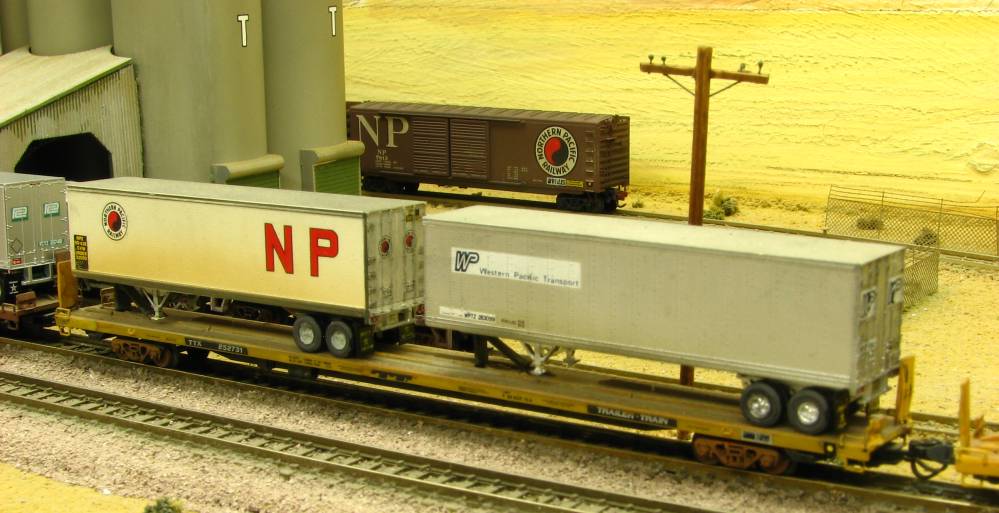
Two custom painted and decaled trailers (Northern Pacific and Western Pacific), both MT models, both lightly weathered.

40 and 20 foot containers of the era.


Sea Land and NOL 40' containers

Again, 40 and two 20 foot containers, weathered

New Athearn trailers. With a Sharpie, you can fill in tail lights' and then reflectors on the sides. Middle of trailer reflector is orange.


Custom WP trailer (MT) and weathered Bangor and Arostook 40 footer.

PC post trailer from Athearn, Kansas City Southern from MT, and a beautiful Caboose Hobbies ATSF waycar.  Santa Fe went on a massive rebuilding program on their cabooses, turning mineral brown waycars into the great looking Red cars with the yellow Circle Cross. 

You can find a "Super C" train similar to this on YouTube at:

http://youtu.be/jAzAaUEIQMY

Monday, August 6, 2012

Santa Fe Extra 1936 East 1974


Freight Paint Schemes

The original freight locomotive paint scheme for cowl locomotives (F3, 7 and 9’s) carried over to 2nd generation diesel power.Freight locomotives delivered in the 60’s and early 70’s carried the blue and yellow stripe paint scheme.This is illustrated by the F45, FP45, SD45, and U23c combo in the video Extra 1936.

Kato U23C Weathered

BLMA fans installed on FP45.  This is a Lima model from the late 70's and powered by a Kato C44-9W with SD45 trucks.

Now, for some of the rolling stock on 1936 East.

UP Yellow cars weather nicely.  Combination of chalks and oils.
Santa Fe started converting mechanical reefers to standard plug door box cars by removing the refrigerator motors.  I had previously removed the roofwalks.  The reference to being a refrigerator car was painted out on the plug door.


Custom painted and decaled 50' dd box.  Note DF decal from Custom Rail Graphics.

Another example of neglected NYC boxcar.  Roof walk removed.  Now labeled for Conrail.

Mildly weathered Deroit, Toledo and Ironton boxcar with roofkalk removed. 

WP weathered Covered Hopper

Mildly weathered GN Covered Hopper

Heavily weathered, custom painted and decaled Santa Fe 50' box car still carrying slogans from the 1950's, Route of El Capitan and the large orange DF, damage free.  Orange DF used on plug door boxcars.

Custom painted Santa Fe 50' panel door boxcar.  This is an old Model Rectifier 50' boxcar with 1960's logos, roofwalk removed.

Cat tractor tied down with silver thread. (cables)

Custom painted Santa Fe Shock Control car from 1960's.  Note dark area on rooftop where the roofwalk was removed.  All the railcars on my layout have roofwalks removed, as when modeling 1981, all roofwalks used in interchange service would have been removed by this late date.

Mildly weathered MILW 60' Hy cube boxcar.  These cars weather up nicely with rust shaded chalks.


Custom painted and decaled 60' Atlas single door boxcar.  Lightly weathered with white added to original paint to "weather" the Indian Red paint.  Note black Santa Fe in the 10'  "Circle Cross".


Custom painted and decaled, heavily weathered 50' boxcar with paint scheme from the mid-1950's. 

Same as above, with Large yellow Damage Free logo used on standard boxcars.
Nicely weatheredd RF&P 50' plugdoor box.


I have seen many of the NdeM cars here in the Southwest.  Many look very beat up.
WFEX mechanical reefer.  Note roofwalk removed.  Mildly weathered.
URTX Milwaukee Rd.

MILW Outside braced mechanical refrigerator car.
ATSF CE-8 Caboose.  The CE-6 caboose had black steps and ends, which I repainted.  Looks like I forgot to relabel the car itself.  Very nice Atlas cabooses. 

Thanks for looking in on my blog.  For a video of this train, look on YouTube at: 

http://youtu.be/dlE-Pwcb5K0


Monday, July 30, 2012

1971 Combined El Capitan and Super Chief


The El Capitan was Santa Fe’s premier all coach passenger train.  In 1956, it received new Hi-Level cars for the entire train.  It lasted 18 months as an independent train before being consolidated under the Super Chief numbers (17 and 18).  The Super Chief, was Santa Fe's premier sleeper train for decades beginning in 1937.
The combined train operated in two divisions, with the El Cap cars in the front and the Super Chief in the rear. This is how it might have looked in the off season (non-summer) in 1971 (just prior to Amtrak in May), when passenger traffic was down.

Leaving Needles, CA

Dining Car-Lounge-Chair Car

17 Roomette Sleeper-Dome Lounge-DiningCar


Combined El Capitan and Super Chief Entering Barstow Yard

Barstow Station


Baggage Dorm car-Chair car

Consist
Baggage
Baggage Dormitory Car
Hi Level Chair Car
Hi Level Chair Car
Hi Level Chair Car
Hi Level Dining Car
Hi Level Lounge CAr
Hi Level Chair Car
Hi Level Chair Car
Hi Level Chair Car
Hi Level Chair Car
4-4-2 Sleeper
10-6 Sleeper
17 Roomette Sleeper*
Dome Lounge Car
Dining Car
17 Roomette Sleeper*
10-6 Sleeper
*I substituted two 17 Roomette Sleepers for the 11 double Bedroom  cars as no car "sides" of 11 double bedroom cars are available from M&R.  The window patterns are close, though.

A video of this train can be found on YouTube at:

                  http://youtu.be/BVxH-uxlHoY