Thursday, October 24, 2013

1981 Manifest Freight led by FP45 5943

1981 Manifest Freight on the Needles Division

This FP45 is a very interesting unit.  It was remanufactured in April of 1980, and became the prototype for FP45 rebuilding program.  It retained its number until early 1982, when it joined its fellow FP45's in the 5990 class as 5993.  It did receive a roof mounted air conditioner, but did not get the smoke deflectors (yuk!) which were installed just forward of the dynamic brake fans on most of the remainder of the 5990 class.
A close up view of the BLMA fans I installed on this FP45 shell, taken from an old Lima manufactured model built in the late 70's.  (I described all the modifications in my April 1st, 2013 blog.)  The model is not weathered, as it was kept very clean for a long time post rebuild, traveling as the lead unit on some of Santa Fe's premium trains.
Nicely weathered SD45 no. 5622.  Santa Fe purchased more SD45 locomotives than any other railroad, purchasing 90 of these 3600 h.p., 20 cylinder behemoths from EMD.  They continued their 20 cylinder fascination by buying an equal number of its successor, the SD45-2. 
Heavily weathered GE unit B23-7 6390.  The B23-7 was an upgrade by General Electric of the U23B model.  It retained 2300 h.p. from its 12 cylinder diesel engine, but got upgrades in the electrical modules and improved floating bolster "B" trucks.
One of two 60 foot Bx-101 boxcars on my Needles division.  This custom painted and weathered car had originally had deep Indian red paint, which has faded over time into a pinkish red.  When painting, I added white to the red to represent the fading.
I love this car.  I saw a few like this in Cajon Pass in the early eighties.  The were holdovers from the mid-fifties.  The model is a Micro Trains 50 foot box, custom painted and decaled, modified with roller bearing trucks and with roofwalk removed.  Heavily weathered, but with recently applied U-1 stencil (black and yellow emblem noting wheel inspection) and black and white consolidated stencil (maintenance records). 
Very cool modernized 40ft boxcar from MT.  No roofwalk, but retains bettendorf trucks.  White door most likely indicates food shipments only.
Stock MT Shock Control car, toned down with dull coat, trucks and wheels painted with weathered black, and consolidated stencil and U-1 wheel inspection emblem added.
Custom painted with faded red.  This is a Super Shock Control car.  These type of cars had couplers that cushioned during both coupling and travel, thus reducing damage to lading.


As shipments of fruits and vegetables were driven to tofc traffic, the need for mechanical refrigerators declined.  On cars such as this, the cooling equipment was removed, and cars converted to carrying regular freight.  This car had the mechanical refrigeration emblem "oranged out" on the blue door, and spot painted where needed.  MT car with roofwalk removed. Masking and painting on quickly repaired cars were never quite symmetrical.


MT car heavily weathered.

Very cool example of an early "Damage Free" 50' box.  This would be a holdover from the 50's, as indicated by the large yellow DF herald.  By 1981, the "Route of the Super Chief " had been gone 12 years.

Nicely weathered UP plug door box by MT.

Missouri Pacific gondola of unknown manufacture.

Custom painted and decaled 50' plug door box on a MT model.


The BN plug door box is nicely weathered in rust, but does not show up in pictures very well.  The Santa Fe 40 foot "Hy-Cube" (high cubic feet, elevated roof) car was designed to ship appliances.
Mildly weathered MT cars


Seeing double
The Richmond, Fredricksburg and Potomac cars have a beautiful shade of blue, contrasted with a silver (aluminum) plug door.  Mildly weathered.  Wide vision Ce-6 caboose.
 
Why the designation Ce?  Santa Fe freight car classes used the first letter and the last letter of the type of car to name the class. Thus, Caboose is Ce, Box is Bx, Flat is Ft, Reefer is Rr, etc..
The number represents a different type of car in that class.

For more information on Santa Fe Shock Control freight cars, please see my article in the March 2006 issue of N Scale Railroading.  In this article, I show 20 different paint schemes used on the red 50' Shock Control cars.


A video of this train can be seen on You Tube at:

                                    http://youtu.be/7-1c1xJvBgQ


Monday, September 16, 2013

1981 Autorack led by GP38 3532

I had been looking on eBay for sometime for someone selling the old N Scale of Nevada replacement panels for the Con Cor Auto Racks.  But then I discovered that Plano models had manufactured the same type of panels in N Scale.  With that, I converted my last five Con Cor cars.  I was able to put together a 31 car Auto Rack special, which you can now view on YouTube.  In a previous blog, I put together an Auto Rack train with my Micro Trains and Red Caboose auto racks.  In this blog, I've pictured just the Con Cor Auto Racks.  Please also note that I modified the MT trucks for close coupling, to better represent the prototype.
 
You can view this video at:

             http://youtu.be/EFwsGoOJVMQ


Atlas GP38 3532, custom painted and heavily weathered.  This unit had a 16 cylinder normally aspirated diesel engine generating 2000 h.p.  These locomotives were designed for local and secondary service where hi horsepower and turbocharging would be wasted.  However, that never stopped using many of their 61 units in mainline service.

Kato SD40-2 5027 "Snoot".  Fresh out of the paint shop.  Custom painted and decaled with all the normal rooftop additions.  After a spree of buying SD45's and SD45-2's from 1967 to 1974, Santa Fe returned to the 16 cylinder 3000 h.p. SD40-2 in 1977, purchasing 187 units thru 1981.  Along with the twenty SD40's bought in 1966, this class represented the largest type of locomotive on the Santa Fe roster.  Each cylinder on the diesel was 645 cubic inches.


Atlas B23-7 6365 heavily weathered. The B23-7 was an upgrade by General Electric of the U23B model.  It retained 2300 h.p. from its 12 cylinder diesel engine, but got upgrades in the electrical modules and improved floating bolster "B" trucks.

U36C 8755, mildly weathered, custom painted.  This is a Kato U30C, with a N Scale of Nevada U36C conversion kit.  N Scale of Nevada is now out of business.  The U36C was manufactured by General Electric, and Santa Fe purchased 100 of these 16 cylinder, 3600h.p. units between 1972 and 1975.


Conrail with Plano panel conversion

Santa Fe in Mineral Brown with Plano panel conversion

Soo Line with Plano panel conversion

Santa Fe with Plano panel conversion

Burlington Northern with Plano panel conversion.

Soo Line with N Scale of Nevada panel conversions.  All the following Auto Racks have the NSN panel conversions.

Santa Fe

Grand Trunk

Chicago and North Western

Conrail
Baltimore and Ohio

Santa Fe in Indian Red, with the "t" on a separate metal placard.

Southern Pacific

Rio Grande

Santa Fe in Mineral Brown


Santa Fe

Canadian National

Thanks for logging on to my blog!  


Monday, August 19, 2013

1981 Manifest Freight Powered by C30-7 8050

Santa Fe C30-7 leading a eastbound manifest freight.  In 1976,  GE C30-7 was introduced as the successor to the U30C locomotive and contained several internal and external design changes.  With 16 cylinders and 3000 h.p., this model was GE's challenge to the EMD SD40-2.  Between 1977 and 1982, Santa Fe purchased 157 of these units.

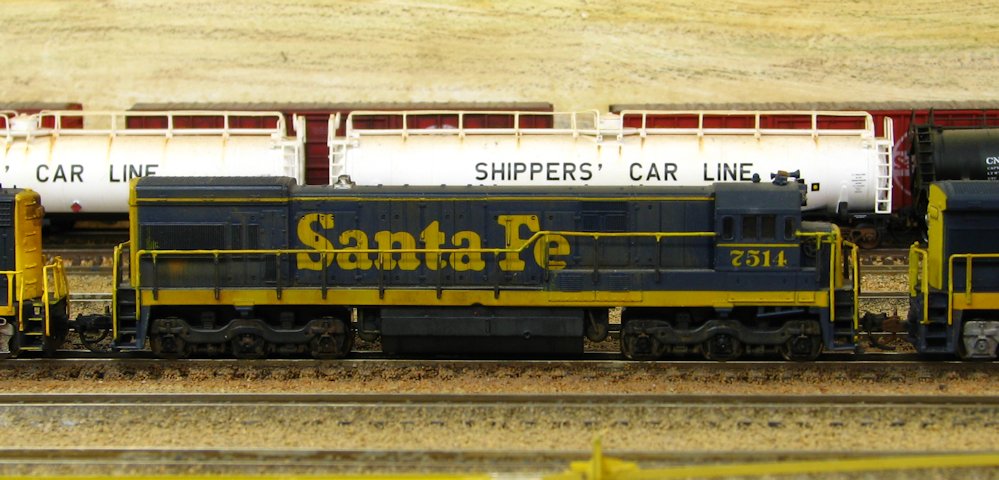
General Electric U23C locomotive 7514 is the second unit in this train.  It was a 2250 h.p. turbocharged loco designed for the intermediate horsepower situations.  They mostly served in the Southwest on copper trains, but occasionally strayed west.  Here she is in the original Yellow Stripe paint scheme.  Santa Fe owned 20 of these units, the largest domestic purchaser of the U23C.


EMD SD45-2 number 5661 is a 3600 h.p., 20 cylinder locomotive, representing the highest horsepower of any regular production locomotive in the 1970's.  That's 20 diesel cylinders at 645 cubic inches each.  (Today's current V-8 gasoline engines run about 300 cubic inches total.)  the diesel engine provided power to run the six electric motors, mounted one per each axle.  In reality, these locomotives are diesel electric locomotives.   Santa Fe owned 90 of these locomotives.

ATSF 60' gondola, heavily weathered as all gondolas should be.  There are two in this train, but just one pictured.

When this Bx-74 box car was refurbished,  it was incorrectly painted red representing a Shock Control car.  It is not.  It should have been painted Mineral Brown.  Who knows why... See "Santa Fe  Freight in color...the series" by Priest and Chenoworth, pg. 45.

Former Mechanical Reefer, now a plug door box, as the quick paint patch indicates.  The diesel refrigerator motor has been removed.

Heavily weathered 55' covered hopper.  I added Gold Medal Models etched brass walkways to this car.

Heavily weathered BN 50'plug door box

A not so stock Micro Trains car.  I removed the "Ship and Travel..." logo and replaced it with Santa Fe billboard lettering.  I really like the looks of this car now.

A very, very old Burlington covered hopper and a heavily weathered NP covered hopper.  I cannot remember the manufacturers of these cars.

MT custom painted GN 50' plug and sliding door box.  This paint scheme is supposed to be in GN "Sky Blue", but the rumor is that shop personnel were just using up the left over "Glacier Green" paint.  Sounds logical, as many cars ended up with this paint scheme.

MT GN covered hopper and Santa Fe covered hopper of a completely different design.

More covered hoppers, weathered

Close up on a Frisco covered hopper.  I believe this and previous model hoppers of this design were manufactured by Athearn.

Addendum:  Brad (of Tracks Across Nevada) informs me that the Airslide hoppers were manufactured by Atlas.  Thanks, Brad.

BN 50' plug door box from Micro Trains.

50' Kansas City Southern outside braced 50' plug door box, mildly weathered and a heavily weathered CB&Q covered hopper.

First appearance of "Beer Tankers" or "Shorty Tankers"

These cars carried many different liquids, but never beer.

Custom painted Chicago, Burlington, and Quincy 40'boxcar.  I added an 8 ft. door per the prototype, then weathered it.  The DF logo refers to "Damage Free".  UP covered hopper nicely weathered.

Stock MT Shock Control car

Double door Conrail boxcar from MT.  When built, these cars were beautiful, with the green and black paint scheme, with the three color NYC logo.  What a mess after Conrail creation.  They all looked like this in the late 70's and early eighties.  So sad.  One of the proudest railroads in the country gone to hell.

Heavy weathering and light weathering

Custom painted and decaled 50' Santa Fe plug door box.  This car was built in the mid fifties as a Damage Free car.  The logo is orange rather than yellow indicating  the freight car is insulated (as lettered below the large DF).  The insulation helped stabilize temperature sensitive lading.

Custom painted Burlington DD 50' boxcar, lightly weathered

Lightly weathered Detroit, Toledo and Ironton 50' plug door box.

Surface rust on this WP 55 ft. covered hopper from Micro Trains

Damage Free 50' boxcar, paint scheme from the 60's.  Atlas caboose completely revamped with caboose parts from MT, including trucks, end rails and ladders, smokestack, and couplers, and then custom painted and decaled. 

A video of this train can be seen on YouTube at:

                                                http://youtu.be/E7g-jDQrORE